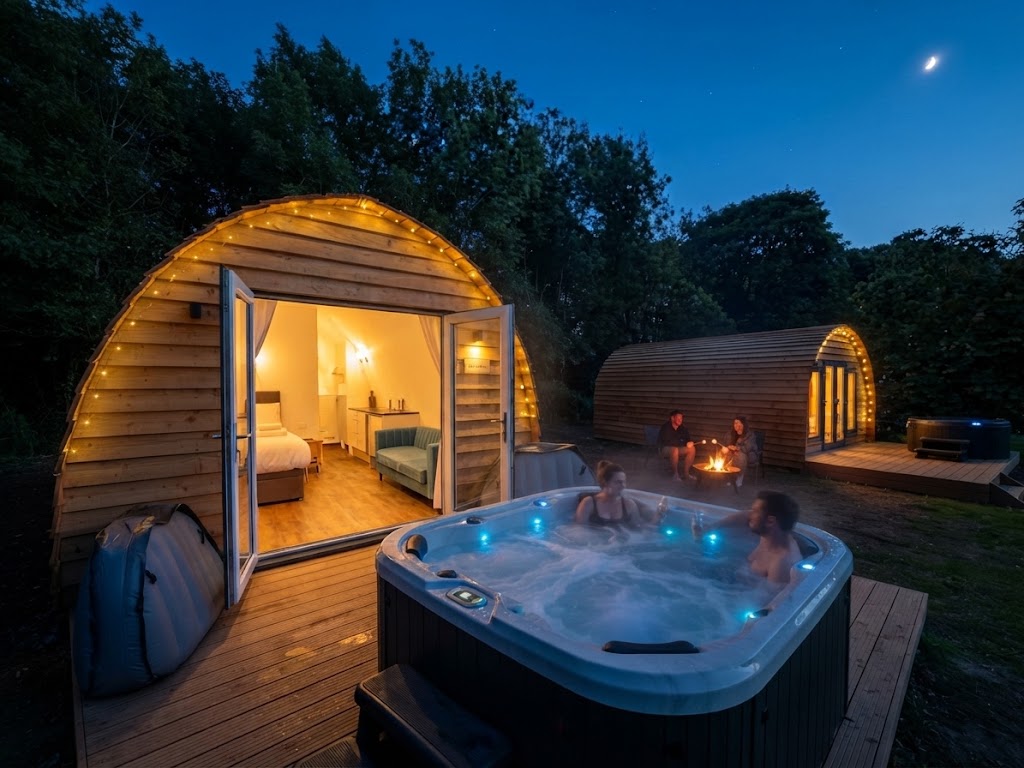
Beyond the standard yurt, Wales runs a genuinely odd accommodation fringe: treehouses, safari tents, hobbit-style earth lodges, converted buses and boats, and bell tents. Prices range £100–£280. Eco credentials are common and usually real. Book unusual units six months out — there's often only one of each. Wye Glamping is the recurring yurt name.
Understanding Glamping Yurts in Wales
What is a Glamping Yurt?
Glamping is comfortable camping — a real bed, heating, and usually a bathroom, in a field. A yurt is the circular Central Asian tent design: lattice wall, roof poles, central crown wheel, canvas over the top. Put the two together and you get a Welsh glamping yurt: wooden floor, rugs, a proper double bed, a wood burner, and a clear dome overhead.
Wales suits it. The country has a long low-impact building tradition, planning authorities have been reasonably receptive to temporary structures, and the landscape rewards accommodation that puts you outside. Yurt sites here run from bare-bones off-grid setups to lined luxury units with private bathrooms.
Why Choose Wales for Glamping?
Three national parks in a country you can cross in three hours. Eryri in the north — 823 square miles, nine mountain ranges, Yr Wyddfa at 1,085m. Bannau Brycheiniog in the south — 520 square miles of sandstone ridges, waterfalls and dark sky. Pembrokeshire Coast in the west, the only coastal national park in Britain.
Eryri gives you the drama: glacial valleys, over a hundred lakes, and mountain walking that ranges from a stroll to a Grade 1 scramble. Yurt sites here are limited by weather and planning, so look at the sheltered valleys.
Bannau Brycheiniog is where most Welsh yurts actually are. Pen y Fan at 886m, Waterfall Country around Ystradfellte with four falls in one walk including Sgwd yr Eira, which you can walk behind. It's been an International Dark Sky Reserve since 2013. Outdoor activity here is gentler than Eryri and better suited to families and dogs.
Exploring Glamping Sites in Wales
Top Glamping Sites Offering Yurts
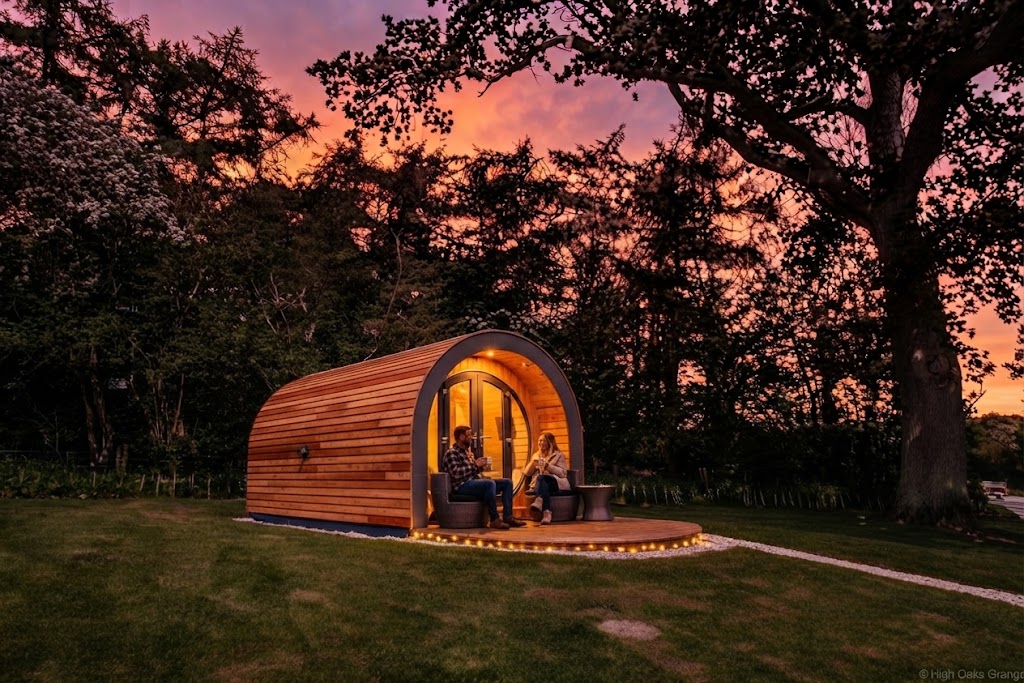
Wye Glamping is the yurt name that recurs most in Welsh searches. It operates in the Wye Valley area, which sits on the English border and is an Area of Outstanding Natural Beauty — steep wooded gorge, the river running through it, Tintern Abbey a few miles downstream.
What sites in this bracket typically offer: furnished yurts with wood burners and real beds, private outdoor space with a fire pit, shared or private facilities depending on the unit, and a location that puts walking, canoeing and the abbey within easy reach.
Unique features to look for when comparing Welsh yurt sites: whether the floor is insulated or a platform over grass, whether the burner is a proper stove or a token one, whether there's electric light, and how far the nearest yurt is. Contact for bookings is usually direct — small yurt operations often don't list on the big platforms, so a phone call or email gets you further than a search.
Luxury and Amenities in Glamping Yurts
Luxury Features of Glamping Yurts
Luxury yurts in Wales tend to include: a fully insulated floor, a lined interior (canvas plus insulation plus an inner fabric layer, which makes an enormous difference in April), a king bed with proper linen, sheepskins, electric or good solar lighting, a private bathroom in an adjacent hut, and a well-equipped kitchen area.
Hot tubs appear at a minority of yurt sites and they're almost always wood-fired, because the sites that run yurts tend to be the sites that avoid mains electricity. A wood-fired tub takes two to three hours to heat and someone has to feed it. That's a commitment, and it's also the best version of the experience — no pump noise, just water, woodsmoke and whatever's overhead.
Does luxury improve a yurt stay? Up to a point. An insulated floor and a good burner transform it. A king bed helps. Beyond that, the appeal of a yurt is partly its simplicity, and sites that over-equip them tend to lose the thing you came for.
Sustainability and Family-Friendly Options
Eco-Friendly Glamping Yurts
Yurts are inherently low impact. No foundations, no mains connection required, removable at the end of the season leaving the field as it was. Welsh sites lean into that.
- Compost toilets — properly designed ones are odourless and save enormous water
- Solar PV and solar thermal — for lighting and showers
- Rainwater harvesting — for washing and flushing
- Reed bed greywater systems — a good sign of proper planning
- Coppiced local firewood — rather than imported kiln-dried
- Wildflower meadow management — pitches mown, the rest left
- No mains electricity at all — at the most committed sites
The Centre for Alternative Technology near Machynlleth has been researching and demonstrating this stuff since 1973 and has trained a lot of the people now running Welsh eco sites. If you want to understand where the ideas came from, it's open to visitors.
Family-Friendly Glamping Experiences
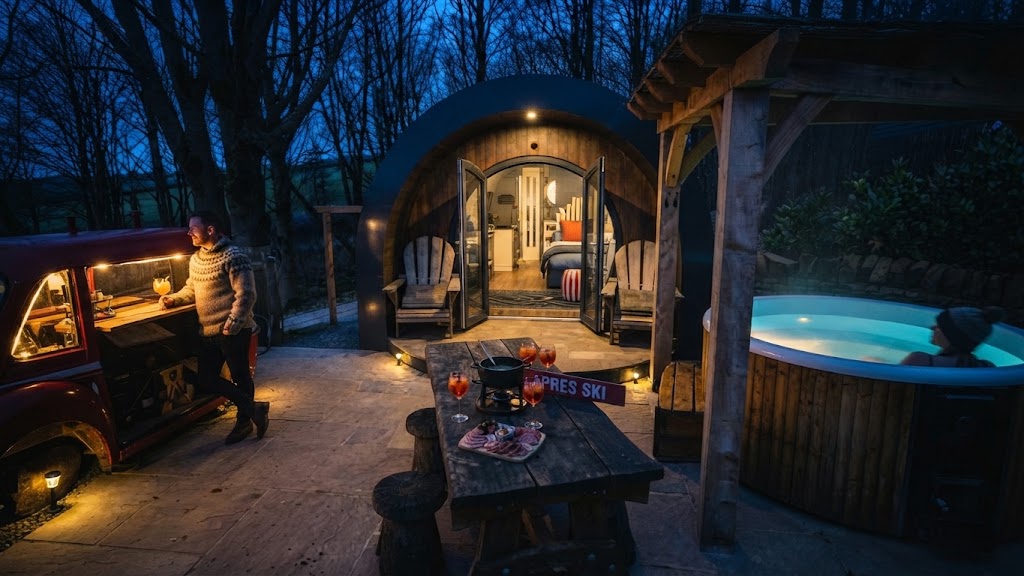
Yurts work well with children for a reason that isn't obvious: the round open space means everyone's together, which small children like and teenagers don't. Under about ten, it's ideal.
What makes a yurt site family-appropriate:
- Enclosed field with no road or unfenced water
- Facilities within sixty seconds — a shared block across a field is hard with a four-year-old at 2am
- A fire pit with supplied wood
- Other families on site, so there are other children
- A stream, a wood or a hill to disappear into
Activities that work: den building, stream damming, marshmallows, stargazing, and rockpooling if you're near the coast. Tips: bring more spare clothes than seems reasonable, bring wellies whatever the forecast, and accept that bedtime will collapse entirely. It's fine.
Unusual Stays Beyond the Yurt
Safari Tents, Treehouses and Bell Tents
Safari tents are the family workhorse — 50 square metres, timber floor, separate bedrooms, gas range, wood burner, covered veranda. £170–£260, April to October. If there are more than four of you, this beats everything else.
Treehouses are the rarest and most oversubscribed. Wales has perhaps a dozen genuine ones — actually built in trees, not on stilts near a tree. Expect £200–£350, a year's notice for peak dates, and a rope bridge you'll photograph more than you use.
Bell tents are the entry point. Canvas cone on a central pole, a bed, maybe a rug. £80–£140, May to September, usually no electricity. Cheap, pretty, and very much a summer proposition.
Hobbit Houses, Buses, Boats and Domes
The genuinely strange end of the Welsh market:
- Hobbit houses — earth-sheltered lodges with turf roofs and curved doors, built into hillsides. Warmer than you'd expect because the earth insulates. A handful exist in west and mid Wales.
- Converted buses — double-deckers and coaches turned into accommodation, usually with a wood burner and a lot of reclaimed timber. More comfortable than it sounds.
- Boats — canal boats on the Monmouthshire and Brecon, and a few static boats on land. The "amazing spaces" category, from the TV series that popularised all of this.
- Geodesic domes — transparent panel over the bed, better insulated than canvas, increasingly common. Often year-round.
- UFO and pod-shaped units — aluminium or fibreglass capsules. Divisive. Some are excellent.
- Shepherd's huts — the most popular unusual unit in Wales. Cast iron wheels, timber body, wood burner, sleeps two. £120–£190.
Booking advice for anything unusual: there is usually exactly one of them. Book six months out for summer, be flexible on dates, and get on the site's mailing list. Cancellations for one-off units get filled from the list before they hit the website.
Booking and Planning Your Glamping Trip
Comparing Prices and Availability
| Unit | Rate | Sleeps | Season |
|---|---|---|---|
| Bell tent | £80–£140 | 2–4 | May–Sep |
| Yurt | £110–£200 | 2–6 | Apr–Oct |
| Shepherd's hut | £120–£190 | 2 | All year |
| Safari tent | £170–£260 | 4–8 | Apr–Oct |
| Dome | £150–£240 | 2–4 | Mostly all year |
| Treehouse | £200–£350 | 2–6 | All year |
| Hobbit house / bus / boat | £130–£250 | 2–6 | Varies |
Price factors: rarity above all — a one-off treehouse can charge what it likes. Then season, size, facilities and location. Availability tips: search Airbnb as well as the glamping platforms, because the weirdest units often list only there. Canopy & Stars curates the high end of this category and is worth browsing even if you book elsewhere.
How to Book a Glamping Yurt
- Decide the unit type — this narrows a huge market fast
- Check the season dates; canvas closes earlier than websites suggest
- Confirm the facilities arrangement, in writing
- Ask about the wood burner: is fuel included, and how much extra if not
- Check access — some off-grid sites involve a walk from the car park with your bags
- Read the cancellation policy before you pay the deposit
Cancellation terms at small Welsh sites are typically 25–50% deposit, non-refundable inside 28 days, sometimes with a date-transfer option instead. Ask about that option — most owners would rather move you than lose you.
Contact: phone beats email for small operators, and email beats a booking form. If a site has one yurt and a landline, phoning is the whole booking process.
Frequently asked questions
What unusual glamping stays are there in Wales?
Treehouses, earth-covered hobbit lodges, converted buses and boats, geodesic domes, shepherd's huts and safari tents. Most are one-off units, so book six months ahead for summer and get on the owner's mailing list for cancellations.
How much does a glamping yurt cost in Wales?
£110–£200 a night for most yurts, up to £260 for luxury lined units with private bathrooms. Bell tents start around £80; treehouses run £200–£350.
Are glamping yurts good for families?
Very good with children under about ten — the open round space suits families and the fire pit does most of the entertaining. Older children usually want their own room, in which case a safari tent works better.
Do glamping yurts in Wales have electricity?
Some do; many are deliberately off-grid, running solar lighting and no sockets. Check before booking if you need to charge anything, and bring a power bank regardless.