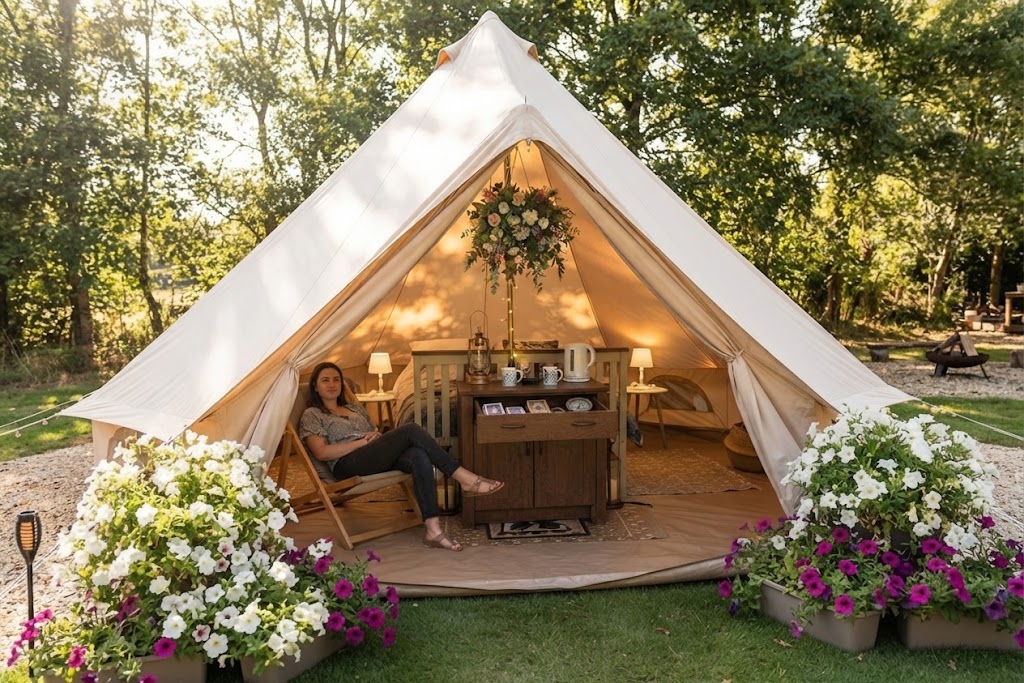
South Wales is weekend country — sites near Abergavenny, Crickhowell and the Usk Valley fill Friday to Sunday and discount midweek. Bannau Brycheiniog (the Brecon Beacons) is an International Dark Sky Reserve and the region's headline draw. Gower has the beaches, Cardiff has the culture. Expect £90–£160 a night, roughly 10% under North Wales.
Introduction to Glamping in South Wales
What is Glamping?
Glamping means sleeping outdoors without the parts of camping that make people give up on camping. A structure with insulation and a lock. A real bed. Heating that works in October. Often a bathroom you don't share with forty strangers.
The contrast with traditional camping is stark once you've done both. Tent camping is cheap — £20 to £35 a pitch — and it's an activity in itself: pitching, cooking on a stove, being cold at 4am. Glamping is accommodation. You arrive, you unlock, you're comfortable. It costs four to five times more and it removes almost all of the friction.
The luxury end has moved a long way. A high-spec South Wales cabin now has underfloor heating, a walk-in shower, a full kitchen and a private hot tub. At that point the only camping element left is the view out of the window, which is rather the idea.
Why Choose South Wales for Glamping?
Geography and access. South Wales sits on the M4, which means Bristol is an hour from the Usk Valley, Birmingham is under two, and London is three. For anyone in southern England, this is the closest properly wild landscape available.
The scenery earns it too. Bannau Brycheiniog — the Brecon Beacons National Park — covers 520 square miles of sandstone ridges, glacial lakes and waterfalls. Pen y Fan at 886m is the highest point in southern Britain. The Gower Peninsula, twenty minutes from Swansea, was designated the UK's first Area of Outstanding Natural Beauty in 1956. The Wye Valley on the English border is another AONB, and the Vale of Glamorgan has a heritage coast most people have never heard of.
Popular glamping pockets: Abergavenny and Crickhowell in the Usk Valley, the Black Mountains, Ystradfellte for waterfall country, Gower for beaches, and the Wye Valley near Monmouth.
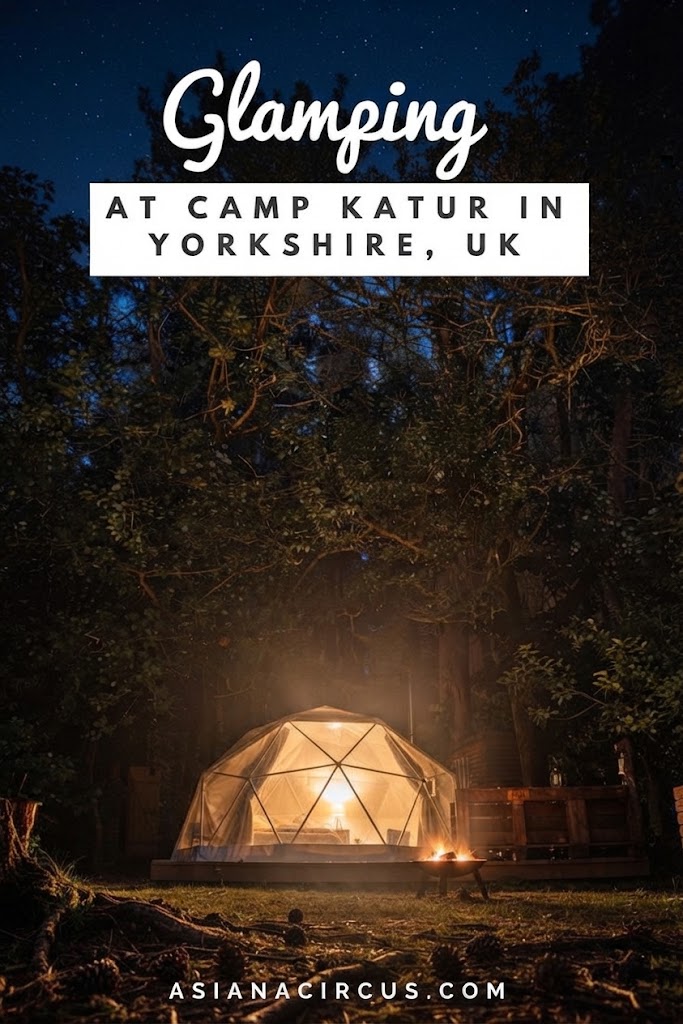
Popular Glamping Sites in South Wales
Exploring HEAD FOR THE HILLS GLAMPING
Head for the Hills is a mid Wales operation sitting in the hills above the Wye, and it's the site name that turns up most often when people ask for a South Wales-ish recommendation with real character. It's small, deliberately, and built around canvas rather than timber.
Accommodation is yurts and safari-style tents, spaced widely across a hillside so each has its own patch of view. Wood burners inside, fire pits outside, compost loos and solar showers on the eco units. There's no Wi-Fi and the phone signal is bad, which is stated up front rather than discovered.
Guest feedback consistently mentions two things: the silence, and the amount of space between units. The recurring practical note is that it's a canvas site, so it's seasonal — roughly April to October — and a wet week is a different experience from a dry one. Bring boots.
Glamping Near Brecon Beacons National Park
The national park is the reason most people book South Wales. It renamed itself Bannau Brycheiniog in 2023, dropping the "Beacons" branding along with its beacon logo, as part of a sustainability repositioning.
What the park gives you:
- Pen y Fan — 886m, the highest peak in south Britain. Two-hour round trip from Storey Arms, and it is always busy.
- Waterfall Country — the Four Waterfalls Walk near Ystradfellte, including Sgwd yr Eira which you can walk behind
- Llangorse Lake — the largest natural lake in south Wales, with watersports and a crannog
- Dark skies — International Dark Sky Reserve status since 2013. On a clear night the difference from an English sky is obvious immediately.
- Caving — Dan yr Ogof and the wider Ogof Ffynnon Ddu system, one of the deepest cave networks in Britain
Sites just outside the boundary near Crickhowell, Talgarth and Sennybridge are cheaper than in-park equivalents and the drive in is fifteen minutes. Park information and current access advice is on the national park authority site.
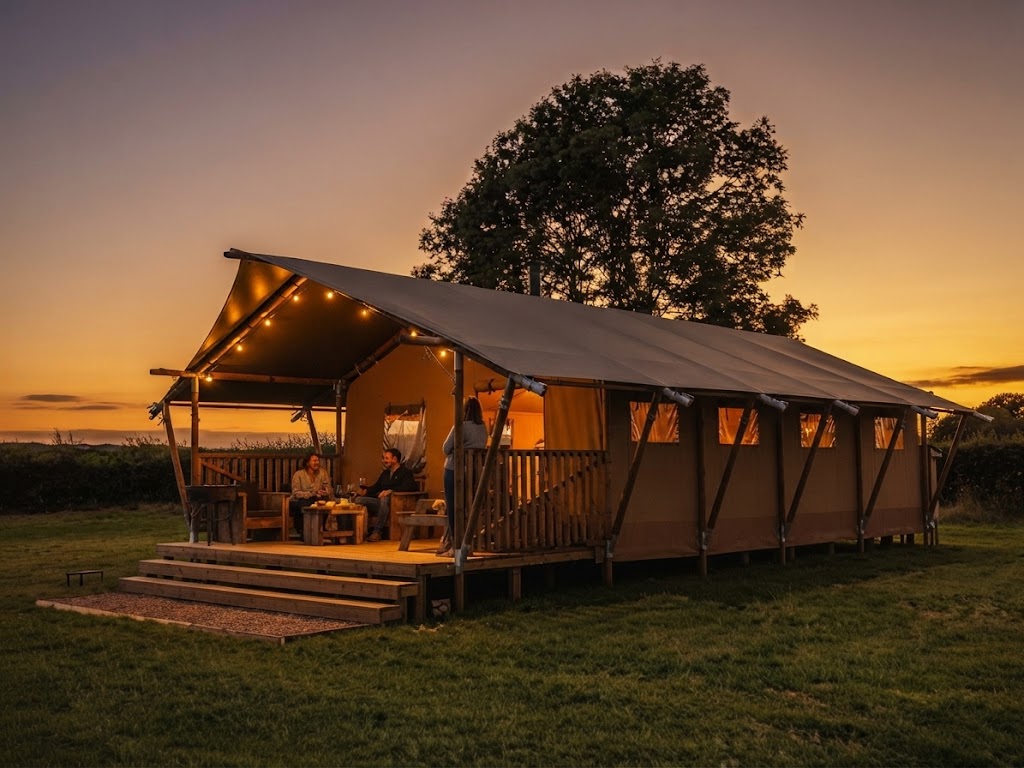
Luxury Features in South Wales Glamping
Luxury Amenities: Hot Tubs and More
South Wales luxury sites offer roughly what the north does, at slightly lower prices. The standard package: private hot tub, ensuite with mains-pressure shower, full kitchen, log burner, decking with furniture, and enough space that neighbours aren't a factor.
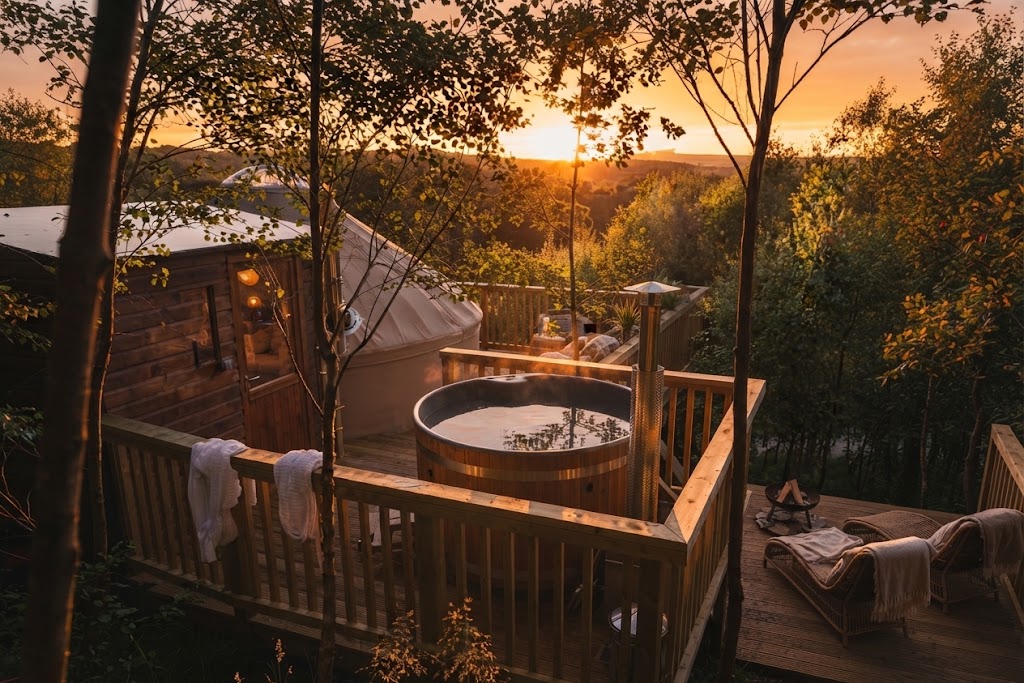
Hot tubs are the headline. In a dark sky reserve they're better than usual — sitting in hot water at 39°C looking at the Milky Way is the specific thing people book South Wales for in winter. Wood-fired tubs are common here because sites lean eco. Full detail on the Wales hot tub page.
Other things that show up at the top of the market: outdoor showers, pizza ovens, firewood included rather than sold, welcome hampers with local produce, and in a few cases a sauna. Rates run £180–£280.
Pet-Friendly Glamping Options
South Wales is the most dog-friendly glamping region in the country, and that's partly a function of the terrain — Brecon Beacons walking is dog-appropriate in a way that scrambling in Eryri isn't.
- Most Usk Valley and Black Mountains sites accept dogs, typically £10 per dog per stay
- Enclosed pitches are common because sites are on working farms with stock
- The Monmouthshire and Brecon Canal towpath is 35 miles of flat, safe, lead-optional walking
- Gower beaches have seasonal restrictions — check before you commit
Guests travelling with dogs consistently rate South Wales sites well. The complaint that recurs is livestock: sheep are everywhere, leads are mandatory on footpaths, and farmers here are legally entitled to shoot a dog worrying stock. Take it seriously.
Unique Accommodation Types
Staying in Yurts: A Unique Experience
The yurt is the signature South Wales unit. Round, canvas over a lattice frame, central wood burner, usually a rug-covered wooden floor and a proper bed. The design is Central Asian and about three thousand years old, which is why it handles wind well — there are no flat surfaces for a gale to push against.
Inside, a well-set-up Welsh yurt is warmer than people expect. The burner throws serious heat into a small round space, and the canvas plus insulation layer holds it. The crown wheel at the top usually has a clear dome, so you can lie in bed and look at the sky.
Limitations, honestly: it's canvas, so it's seasonal (April to October at most sites), sound travels, and if it rains for four days everything feels slightly damp. Guests who love them love them completely. Guests who wanted a hotel room are disappointed. More on the format on our yurt stays page.
Eco-Friendly Glamping Choices
Eco credentials in South Wales tend to be substantive rather than marketing. The region has a strong low-impact building tradition — the Centre for Alternative Technology near Machynlleth has been running since 1973 and has influenced a generation of Welsh site owners.
What to look for:
- Compost toilets — properly built ones don't smell, and they save enormous amounts of water
- Solar hot water and PV — common, and often the site's only power source
- Wood-fired heating and tubs — locally coppiced fuel at the better sites
- Reed bed greywater systems — a good sign that someone thought about this properly
- No-car pitches and cycle access — rarer, but they exist
Guests who stay at genuinely low-impact sites tend to report the same thing: the constraints improve the holiday. No electricity means candles and conversation. Solar showers mean you shower in the afternoon when the water's hot. It's a different rhythm and most people adapt to it in about a day.
Booking and Reviews
How to Book Your Glamping Experience
South Wales books on a weekend rhythm, unlike the north's holiday rhythm. That creates a specific opportunity: midweek availability is good all year and often 30% cheaper.
- Book early for — every weekend May to September, bank holidays, and the Hay Festival period in late May, which fills accommodation for thirty miles
- Easy to get — Sunday to Thursday, any month; all of November and January
- Book direct — small sites here answer email quickly and will usually beat platform pricing
- Two-night minimums — standard Friday and Saturday, waived midweek at many sites
Also see the sub-regions: Gower Peninsula and Swansea and Gower both have their own pages, and Cardiff-adjacent sites are covered there too.
Top Reviewed Glamping Sites in South Wales
Reading South Wales reviews, a few patterns hold. Sites that score highest tend to be small — under six units — and owner-run. Sites that score worst are usually larger operations where the glamping was bolted onto an existing caravan park.
Recurring praise: dark skies, fire pits, owners who leave you alone, and the walking straight from the gate. Recurring complaints: mud in wet months, midges near water in July, and canvas sites being colder than expected in shoulder season.
Read winter reviews if you're booking winter. A site that's idyllic in June can be a bog in February, and only the January reviewers will tell you.
Frequently asked questions
What is the best area for glamping in South Wales?
The Usk Valley around Abergavenny and Crickhowell, for most people — it's inside the Brecon Beacons, close to the M4, and has the widest choice of sites. Gower is better for beaches, and the Wye Valley is better if you're coming from Bristol or the Midlands.
Is glamping in South Wales cheaper than North Wales?
Slightly — about 10% on like-for-like units. The bigger saving is midweek, when South Wales sites discount heavily because their demand is weekend-shaped.
Can you see the stars from South Wales glamping sites?
Yes, and it's a genuine selling point. Bannau Brycheiniog has been an International Dark Sky Reserve since 2013. Sites inside and just outside the park routinely get Milky Way visibility on clear moonless nights.
Are there glamping sites near Cardiff?
Several, mostly in the Vale of Glamorgan and the valleys to the north. Expect 30–45 minutes' drive from the city. They're convenient rather than spectacular — for scenery, push on to the Brecon Beacons or Gower.