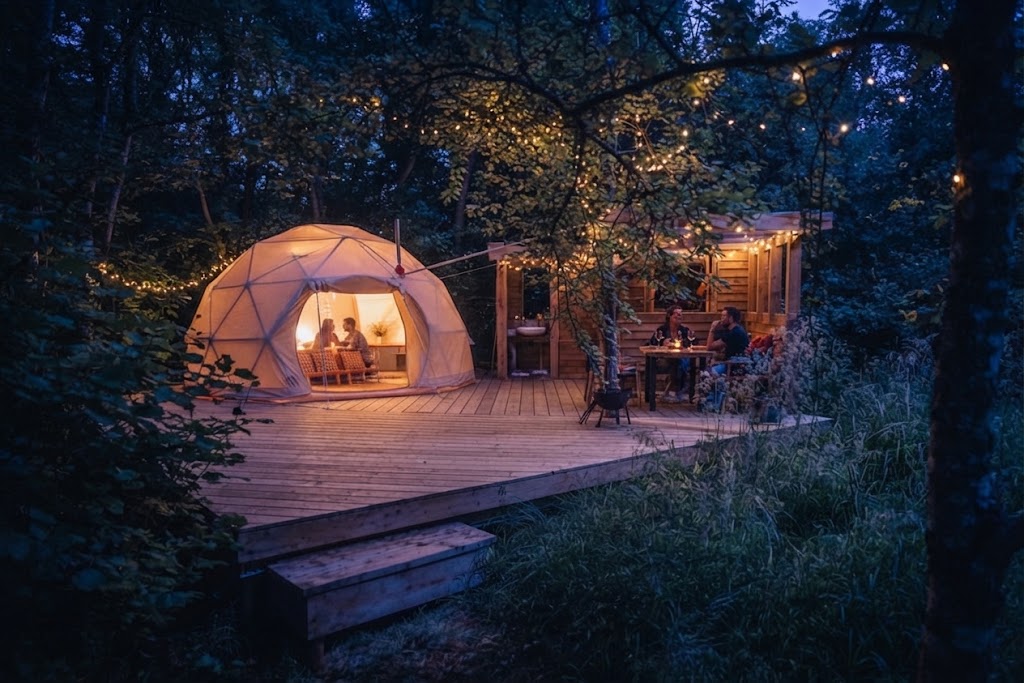
Hot tub glamping in Wales runs £140–£300 a night. The key distinctions: private versus shared, wood-fired versus electric, and whether the tub is screened from neighbours. Wood-fired tubs are better and slower. North Wales and Pembrokeshire have the most stock; mid Wales is cheapest. Book winter for the best combination of price and atmosphere.
Discover Glamping Sites in Wales
Top Glamping Destinations in Wales
Hot tub glamping isn't spread evenly across Wales. It concentrates where two things overlap: a view worth sitting in, and enough demand to justify the running cost. A hot tub costs a site roughly £3–£6 a day in electricity and chemicals, plus maintenance, so they only appear where guests will pay for them.
- North Wales / Conwy and Llŷn — the biggest concentration. Mountain and sea views, closest to the northern English cities. Detail here.
- Pembrokeshire and Tenby — coastal, premium pricing, books out early. Pembrokeshire guide.
- Brecon Beacons — dark skies plus hot water is a strong combination. Best value of the national parks.
- Mid Wales / Ceredigion — cheapest, emptiest, longest drive from anywhere
- Gower and Swansea — small number of sites, high demand, beach access. Swansea and Gower.
Travel tip that saves money: the further you're prepared to drive from the M4 or A55, the less you pay. A tub in Ceredigion costs 25% less than the equivalent in Conwy, and the sky is darker.
Glamping Sites with Hot Tubs
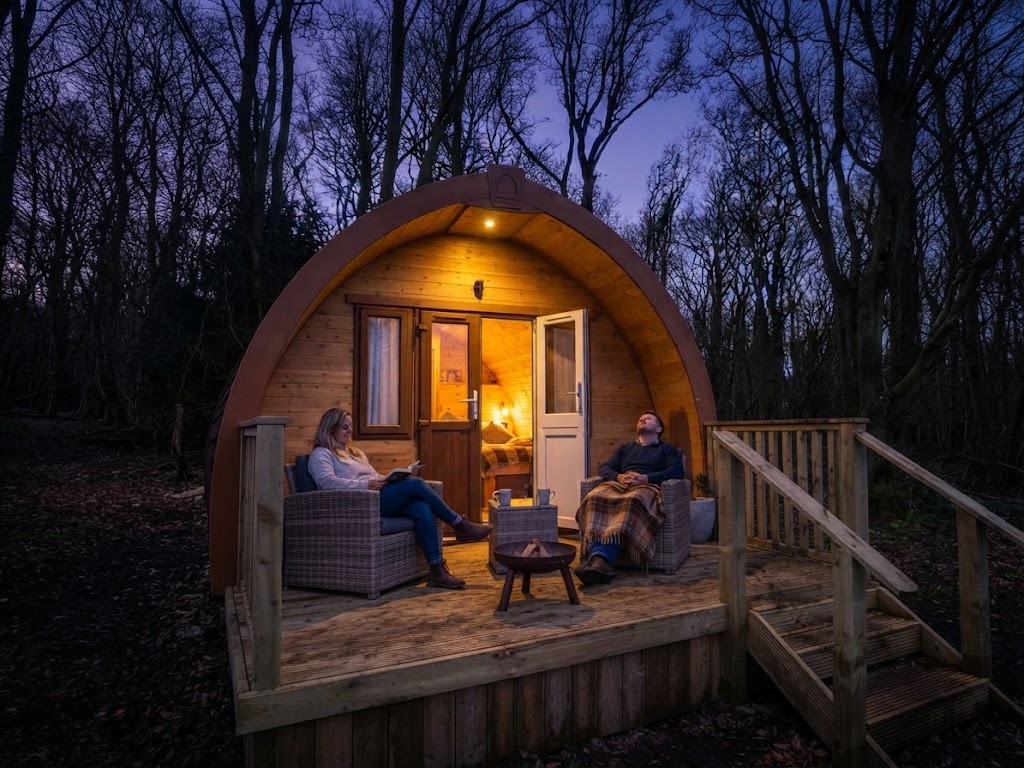
Every accommodation type in Wales now comes in a hot tub variant. Pods are the most common — see our pods with hot tubs page — but yurts, safari tents, shepherd's huts and cabins all appear with them.
The benefit of choosing a site with a tub isn't just the tub. It signals a certain level of operation. A site that runs hot tubs has to test water daily, keep chemicals stocked and maintain pumps. Sites that can't be bothered with that generally can't be bothered with much else either. It's an imperfect proxy for quality but it's not a bad one.
Booking-wise, hot tub units at any site sell first. If a site has eight pods and two with tubs, those two are booked six months out and the other six have availability next weekend.
Explore Hot Tub Options
Types of Hot Tubs Available
| Type | Heat-up time | Temperature | Pros | Cons |
|---|---|---|---|---|
| Electric acrylic spa | Always on | 38–40°C, stable | Ready instantly, jets, lighting | Looks like a garden centre product |
| Wood-fired cedar tub | 2–3 hours | Variable, you control it | Beautiful, no electricity, smells of woodsmoke | Slow, needs tending, can overheat |
| Wood-fired with electric backup | 1–2 hours | Stable | Best of both | Rare, expensive |
| Inflatable | 8–12 hours | Struggles below 5°C outside | Cheap for the site | Avoid. It's a paddling pool. |
Wood-fired tubs are the ones people remember. There's a snorkel stove sitting in the water, you feed it logs, and the water heats by convection. Two hours later you're in 39°C water with woodsmoke drifting past and no pump noise at all. Electric tubs hum. Wood-fired ones don't, and that silence is a bigger part of the experience than you'd guess.
Eco angle: a wood-fired tub uses no electricity and burns a renewable local fuel. Several Welsh sites run them specifically as part of a low-impact pitch, alongside compost loos and solar lighting. If sustainability matters to you, ask — the good sites will have a proper answer.
Privacy and Exclusivity
This is where most bookings go wrong. Three arrangements exist and they're marketed almost identically:
- Private tub, attached to your unit — yours alone for the stay. This is what you want.
- Private tub, shared decking — yours, but visible to and from neighbouring units. Fine with a hedge, awkward without.
- Communal tub, slot-booked — one tub, everyone shares, you book an hour. Cheap and not what most people picture.
Questions worth emailing before you book: Is the tub exclusively ours for the whole stay? Is it screened, and by what — fencing, hedge, trees? How far is the nearest other unit? Can it be seen from the site's access track?
Sites offering real seclusion — one unit in its own field or woodland clearing — charge £40–£60 more and it's the difference between relaxing and keeping a towel to hand. Worth it.
Immerse in the Welsh Landscape
The Beauty of the Welsh Landscape
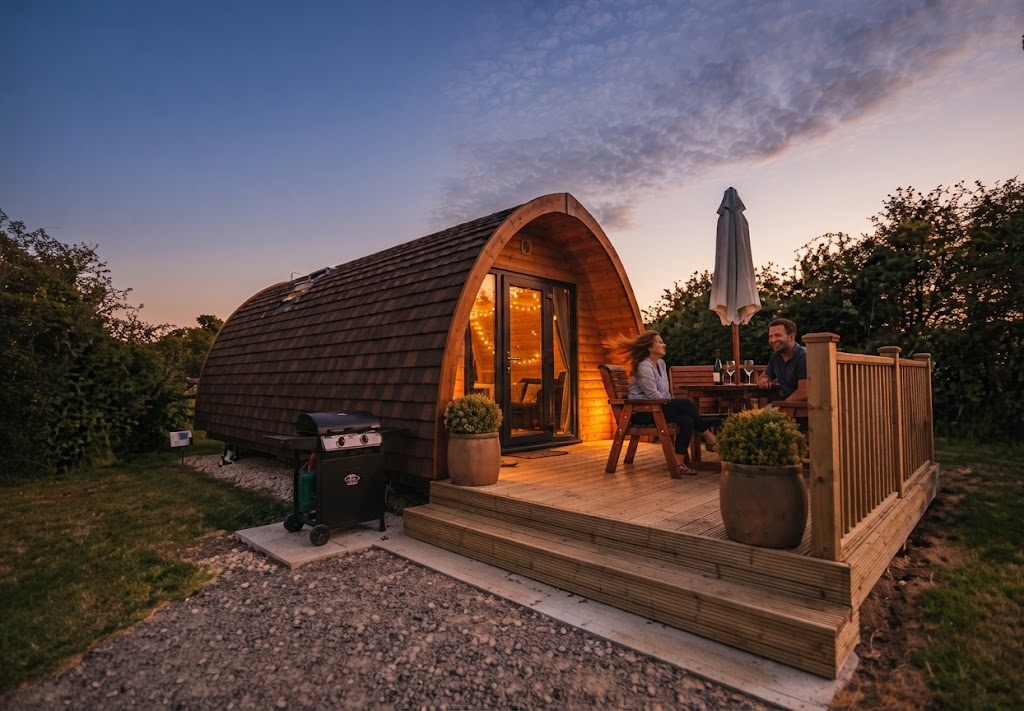
The Welsh landscape is compressed. Within a forty-minute radius of most glamping sites you'll find mountain, river valley, ancient woodland and coast. That's unusual — it's why the country supports three national parks and five AONBs in an area you could drive across in three hours.
Geology does a lot of the work. Wales gave its name to two geological periods (Cambrian and Ordovician, both named after Welsh tribes) because the rock here is old and exposed. Glaciation carved the valleys. The result is steep, dramatic, and green in a way that requires the rainfall people complain about.
From a hot tub, the landscape does something specific: it removes the sense of being at a campsite. Face a tub at a mountain or an estuary and you're in the view. Face it at a car park and you're in a car park.
Accommodation Types: Cabins and More
Cabins are the natural hot tub pairing. They're insulated, year-round, and have the space to hang wet things. Yurts and safari tents with tubs are lovely in July and mostly closed by November.
| Unit | With hot tub, typical rate | Season | Best for |
|---|---|---|---|
| Pod | £150–£190 | All year | Couples, short breaks |
| Shepherd's hut | £165–£220 | All year | Romantic two-night stays |
| Cabin / lodge | £200–£300 | All year | Comfort, winter, longer stays |
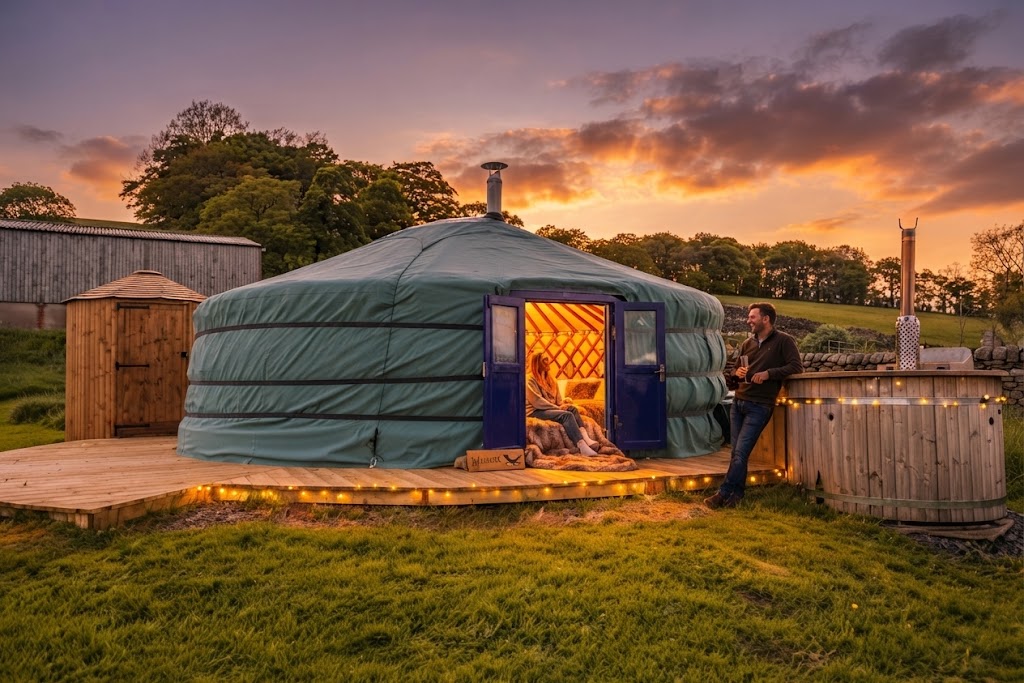
| Yurt | £160–£240 | Apr–Oct | Atmosphere, families |
| Safari tent | £190–£280 | Apr–Oct | Groups of four to eight |
More on the individual formats: yurts, pods, and the luxury tier including shepherd's huts.
Adventure and Activities
Adventure Activities Near Glamping Sites
Wales invented several of the things people now travel here to do. Coasteering started in Pembrokeshire. Modern zip line tourism arguably started at Penrhyn Quarry. The mountain biking at Coed y Brenin was Britain's first purpose-built trail centre.
- Coasteering — Pembrokeshire, St Davids, Anglesey. Wetsuit, helmet, jumping off things into the sea.
- Zip World — Velocity 2, 125mph, Penrhyn Quarry. Also underground trampolines at Blaenau.
- Mountain biking — Coed y Brenin, Antur Stiniog, BikePark Wales near Merthyr
- Surfing — Freshwater West, Rhosneigr, Llangennith on Gower
- Hiking — Yr Wyddfa, Pen y Fan, Cadair Idris, the Pembrokeshire Coast Path
- Caving and gorge walking — Brecon Beacons, particularly around Ystradfellte
The rhythm that works: hard activity in the day, tub in the evening. Don't book adventure activities for consecutive days unless everyone's genuinely fit — Welsh terrain is steeper than the map suggests, and a day two of nothing but a hot tub and a book is not a wasted day.
Safety: check tide times for anything coastal, tell someone your route in the mountains, and take the mountain weather forecast seriously. Conditions at 900m bear no relation to conditions at the car park.
Making the Best Booking Decision
Comparing Prices and Availability
Price drivers, in order of impact: season, privacy, unit size, region, tub type. A private tub in a secluded Pembrokeshire cabin in August might be £310. The same specification in Ceredigion in February is £145.
- Peak — mid-July to end of August, Christmas week, Valentine's, bank holidays
- Shoulder — May, June, September, October. Best balance.
- Off-peak — November to March excluding holidays. Cheapest, and hot tubs are at their best.
Availability follows the same curve but hot tub units sit about six weeks ahead of standard units on the booking calendar. If a site's ordinary pods are showing free in three weeks, its tub pods have probably been gone for two months.
Reviews and Ratings
For hot tub stays specifically, reviews matter more than usual because water quality is invisible in photographs. Look for:
- Recent reviews mentioning the water being clean and clear
- Any mention of how often the tub is emptied and refilled (weekly between guests is the standard you want)
- Comments on privacy from people who stayed in your specific unit
- Whether the site provides robes and towels
Sources: Google reviews are the least filtered. Site-hosted testimonials are curated and near-worthless. Pitchup and Canopy & Stars reviews are verified-stay only, which makes them more reliable.
Final Booking Tips
A checklist, condensed:
- Confirm the tub is private and exclusive for your dates
- Ask whether it's wood-fired, and if so who lights it and when
- Check screening — hedge, fence or trees, not "a bit of a gap"
- Verify the bathroom is ensuite if you're staying more than one night
- Book midweek off-peak if price matters, summer weekends six months out if it doesn't
- Pack robes, flip-flops, and a second towel per person
- Balance the trip — one big activity day, one slow day, repeat
The stays people remember aren't the most expensive ones. They're the ones where the tub faced something worth looking at and nobody could see in.
Frequently asked questions
How much does glamping with a hot tub cost in Wales?
£140–£190 for a pod or hut with a private tub, £200–£300 for a luxury cabin or safari tent. Off-peak midweek can fall to £120; August coastal peaks around £320.
What's the difference between a wood-fired and electric hot tub?
Electric tubs are thermostatically controlled and ready on arrival. Wood-fired tubs heat by a submerged stove, take two to three hours, and need tending — but they're silent, use no electricity, and most people find them the better experience.
Are hot tubs at Welsh glamping sites cleaned between guests?
Reputable sites drain, clean and refill between bookings, and test chemical levels daily during a stay. Ask if it isn't stated. Cloudy water in recent reviews is a reliable warning sign.
Can you get glamping with a hot tub in Wales for one night?
Rarely at weekends — two-night minimums are standard. Midweek single nights exist off-peak, usually with a surcharge. Pods are the most likely format to allow it.